As Typhoon Fung-wong approaches the Philippines, over 900,000 people have been evacuated.
Super typhoon conditions emerged with sustained winds of 185 km/h (115mph) and gusts of 230 km/h (143mph) as the storm approached Sunday evening.
The Philippine meteorological agency warns of a “high-risk of life-threatening and damaging storm surge with peak heights exceeding 3m [10ft]” as the storm approaches north-west into Luzon, the country’s most populous island.
Fung-wong, known locally as Uwan, comes days after Kalmaegi, which killed nearly 200 people.
The storm initially reached eastern Bicol on Sunday morning and passed over the Polillo Islands on Sunday afternoon.
Nearly 300 flights have been cancelled, and several schools have relocated Monday classes online.
Fung-wong is forecast to weaken after making landfall between Baler and Casiguran, although it will likely stay a typhoon over Luzon.
For portions of Luzon, over 200mm of rain is anticipated, including 100-200mm in Metro Manila. This is expected to result in significant flooding and landslides.
On Saturday evening, a weather official reported intense rains and winds had begun in the eastern Philippines.
While much of the country is predicted to be affected, Catanduanes, an island in the eastern part of Bicol, was reported to be in dire circumstances on Sunday morning.
By Sunday morning, residents in low-lying and coastal districts were advised to relocate to higher ground.
Global Pulse News interviewed Hagunoy, 21, who works at one of Sabang’s dozen coastal hotels in Aurora, eastern Luzon.
He said police had visited guests several times in recent days to evacuate them before the storm. All hotels were empty on Sunday morning.
Hagunoy said he would defend the property as long as he could before riding his motorbike home to safety as the tide rose fast.
Staff locked the gates and roped off the windows to prevent wind-shattered glass from entering.
More than 200 individuals sought sanctuary in a sports centre in central Aurora. Many parents bring little children too young to remember 2013’s Typhoon Haiyan, which killed over 6,000 people in the Philippines.
Fung-wong also halted rescue attempts after Kalmaegi, one of the strongest typhoons this year, passed.
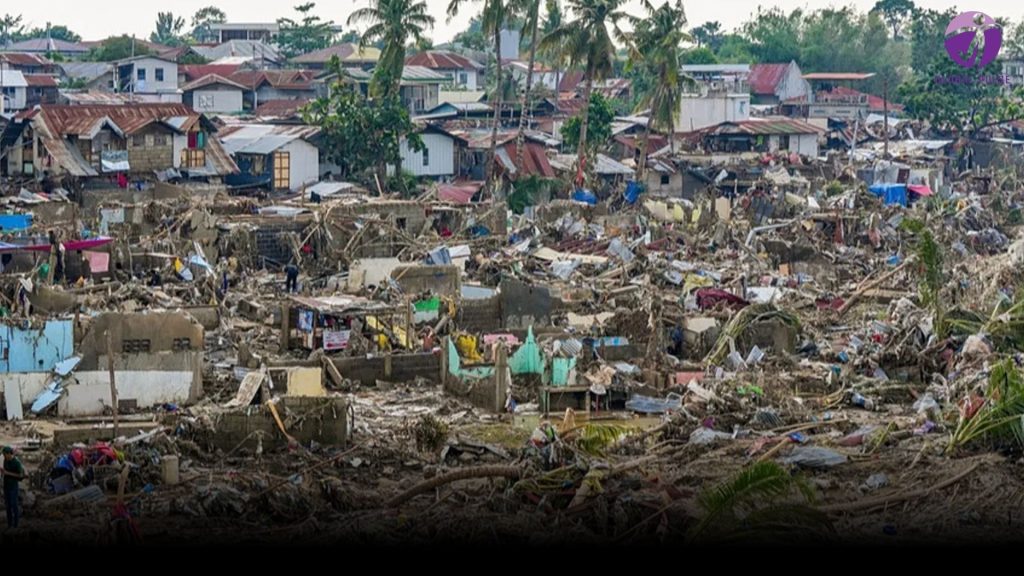
Mud poured down hillsides and into neighbourhoods after heavy rain. Fast-moving flash floods destroyed impoverished neighbourhoods.
At least 204 people died in the Philippines from the earlier storm, and more than 100 are missing.
In Vietnam, severe winds destroyed trees, tore off roofs, and smashed enormous windows, killing five.
The Philippines declared a state of calamity after Typhoon Kalmaegi, and in preparation for the next storm.
Government organisations can now access emergency funds and expedite the delivery of vital goods and services.
Kalmaegi’s devastation has made some Filipinos more apprehensive about the storm.
“We evacuated because the recent typhoon brought floods in our area, and now I just want to keep my family safe,” Norlito Dugan told AFP.
He is among those sheltering in a church in Sorsogon on the island of Luzon.
Resident Maxine Dugan stated, “I’m here because the waves near my house are now huge.”
The Philippines, situated near the Pacific Ocean’s tropical weather systems, is one of the most vulnerable countries to cyclones.
Approximately 20 tropical cyclones originate there annually, with half of these affecting the country.
The number of global hurricanes, typhoons, and cyclones is not expected to increase due to climate change.
However, climate change-fueled warmer oceans and atmosphere may intensify those that form. That might increase wind speeds, rainfall, and coastal flooding.